Problem: You See a Ceiling Stain But Cannot Find the Source
Flat roof leaks rarely sit directly above the interior damage. Water enters at a seam, a fastener back out, or a flashing detail, then travels along the deck or insulation board until it hits a low spot or a penetration. Property managers in Center Grove often spend hours on the roof with a flashlight and come down with nothing to show for it. Meanwhile drywall keeps swelling and tenants keep calling.
Solution: Methodical Leak Path Tracing
A real leak hunt on a flat roof starts inside, not outside. We map every stain, drip line, and moisture reading on the ceiling and tie those points back to roof penetrations above. From there the crew walks the membrane systematically, checking field seams, perimeter terminations, pipe boots, HVAC curbs, scuppers, and drain bowls. Thermal imaging helps locate wet insulation under the membrane, and a moisture meter confirms whether the deck is saturated. For a deeper look at how we handle interior detection alongside the roof work, our piece on moisture mapping with thermal imaging walks through the process we use.
On larger roofs we also sketch a simple grid and log every suspect spot with a photo and a GPS pin. That record matters later when a second leak shows up three months out and you need to know whether it is a new failure or a missed entry point from the first visit. Center Grove Commercial Roofing keeps that file on hand so the next tech who climbs your roof is not starting from zero.
Solution: Honest Repair vs Replace Math
Here is how typical flat roof spending breaks down in Center Grove so you can see where your situation falls:
- Single seam or boot repair: roughly $450 to $1,200.
- Multi point membrane repair: roughly $1,500 to $3,500.
- Section replacement with wet insulation removal: roughly $4,000 to $8,500, with coating restoration running $3.50 to $7.50 per square foot and full membrane replacement landing in the $9 to $16 per square foot range.
Ranges reflect typical Central Indiana conditions and vary with access, deck condition, and membrane type. If repeated repairs are stacking up past roughly thirty percent of replacement cost, replacement usually wins on a five year horizon. For a longer look at the decision, our breakdown of commercial roof restoration vs replacement covers the tradeoffs in more depth.
Solution: A Light Annual Walk and Drain Cleaning
A short spring and fall inspection catches the small stuff before it becomes a ceiling stain. Center Grove Commercial Roofing keeps notes from the prior visit so each walk builds on the last one, and most Center Grove buildings need only minor sealant work and drain clearing to stay tight through the next season.
Problem: You Are Not Sure If Repair Still Makes Sense
At some point patches stop being economical. If the membrane is brittle across the field, if insulation is wet over more than a quarter of the roof area, or if you are calling for repairs three or four times a year, you are funding a replacement one patch at a time.
Problem: The Last Contractor Did Not Stand Behind the Work
Property owners tell us this constantly. A patch held for a season, then the leak came back two feet away, and the original crew stopped returning calls.
Solution: Documentation, Photos, and a Crew That Comes Back
Every repair we complete gets photographed before and after, with the location noted on a roof plan so you have a record of what was done and where. If something we repaired fails inside the workmanship window, we come back. If we cannot help, we will tell you that on the first call instead of wasting your time.
Problem: The Membrane Is Splitting at Seams and Penetrations
EPDM, TPO, and modified bitumen all fail at predictable spots. Seams open when the adhesive ages out. Pipe boots crack where the rubber meets the pipe. Parapet flashings pull loose from years of thermal movement. In Center Grove, freeze thaw cycles widen these openings every winter, and the spring rain finds them on the first heavy storm.
Solution: Targeted Repairs That Match the Membrane
Spot repairs only hold if the patch material is compatible with what is already up there. We carry EPDM cover tape, TPO weld patches, and modified bitumen torch or cold applied patches so the crew can match the system on site. Typical repairs include:
- Reseaming open laps with primer and cover tape, then sealing the edge with lap sealant.
- Replacing failed pipe boots and resealing around HVAC curbs with new termination bar and sealant.
- Stripping in cracked parapet flashings with new membrane and mechanical fastening at the top edge.
When the repair is straightforward and the surrounding membrane has life left, a targeted fix can carry the roof for several more years. We also note any secondary issues found during the repair walk, like clogged drains, missing drain strainers, or ponding water that sits more than 48 hours after a storm. Those items rarely cause the call, but they shorten the life of every repair you pay for if they are left alone.
Problem: You Want to Stop Calling for Repairs Every Spring
Reactive repair is expensive. Each call costs a trip charge, a minimum labor block, and another day of interior disruption that adds up across a portfolio.
Problem: Water Is Already Coming Through, Right Now
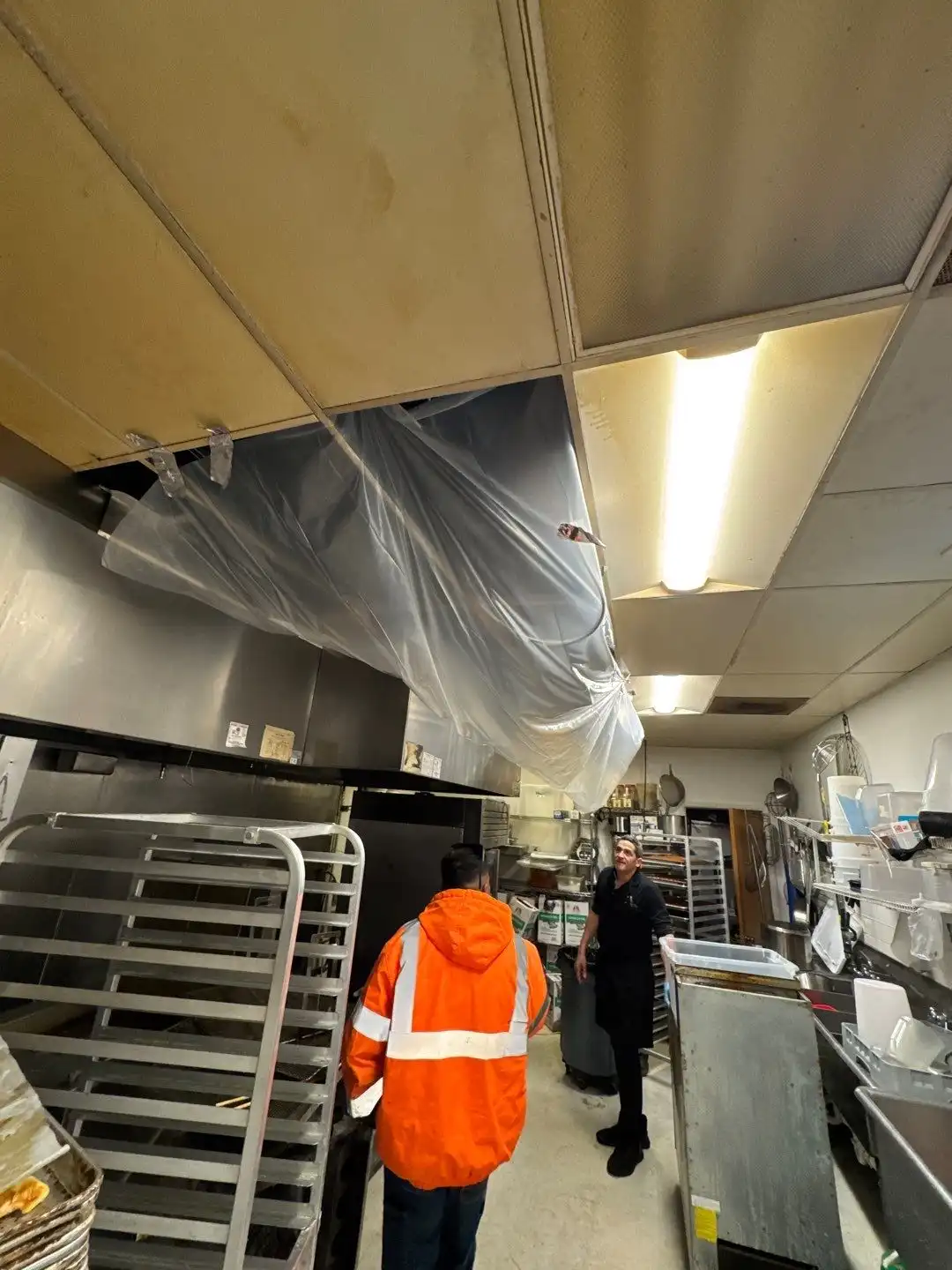
An active leak during a storm is a different situation. You need the water stopped before you worry about a permanent fix. Soaked insulation, wet ceiling tiles, and dripping fluorescent fixtures create real risk for both the building and anyone inside it.
Solution: Temporary Dry-In, Then Permanent Repair
For active leaks we prioritize tarping and dry in work so the interior stops taking on water. Severity is assessed over the phone so we know what materials and crew size to bring before anyone leaves the shop. That buys time to dry out the affected areas and plan a real repair once conditions allow. While the roof is being stabilized, our team can also handle the interior side, which often overlaps with our attic water damage from roof leaks process for residential structures and commercial drying for larger buildings.